Dissolution of Marriage inquiries in Greenville County begin with the public index at https://www2.greenvillecounty.org/scjd/publicindex/, where you can run a Greenville County divorce records search or a Greenville County divorce record lookup by spouse name, case number, or filing date. The portal lists Greenville County divorce case records, final divorce decree, and judgment details, plus family court case search results for property division or child custody orders. Quick access saves time and clarifies case status without a courthouse visit.
Dissolution of Marriage seekers often need a certified copy of a Greenville County divorce decree or final judgment for legal or personal reasons. Request forms, record fees, and processing time are outlined on the official website, and the clerk’s office at 305 East North Street can verify divorce record accuracy or resolve missing filings. Whether you’re reviewing Greenville County marriage dissolution records, divorce petition, or post‑judgment modifications, the system provides clear steps for secure, confidential access.
How to Search Dissolution of Marriage
Dissolution of Marriage is the legal case name used in South Carolina for a case that ends a marriage through court order. A Greenville County dissolution of marriage search can lead you to the case number, filing date, case status, and decree details. Users can also reference court records for additional information. The public index serves as a search tool rather than a certified copy of the court file. It helps you find the right case before requesting records from the Greenville County Clerk of Court.
Official Search Portal: https://www2.greenvillecounty.org/scjd/publicindex/
Steps to Search
- Open the official public index in a current browser. The address above is the direct starting point for a Greenville County divorce records search. Keep the portal open so you can compare its search fields with any case numbers, names, or dates found on your papers.
- Set the court and county before reviewing the results. The statewide index may return cases from other places, so choose Greenville County and the correct family court. An exact county choice keeps a similar case in another location from taking your attention.
- Choose the Dissolution of Marriage or family court case type shown on the form. People often call these divorce cases, while the court uses Dissolution of Marriage as its formal term. If the form separates case categories, select the one that matches the wording on the case papers.
- Search by the legal name of a spouse. Enter the surname and given name as the court lists them, starting with the name used when the case began. A Greenville County divorce record lookup by name works best when both parts of the name match.
- Search by case number when one appears on a filing, hearing notice, or other court paper. Copy the full number, including every suffix shown on the document. A case number gives the strongest match because it points to one court file.
- Use the filing-date fields to narrow the search. The filing date marks the start of the divorce petition or complaint, not the date the marriage ended. If you know only the year, enter a wider date range and then review the event dates shown for each result.
- Read the case status and event history. Look for entries marked pending, finalized, dismissed, amended, or closed. The date for a decree or entered judgment can differ from the filing date, so treat each date as a separate point in the case.
- Confirm the match before requesting a copy. Open any document image offered with the result and check the case number, parties, and court. The public index is not the clerk’s certified copy, so request a certified divorce decree or another paper directly from the Greenville County Clerk of Court.
What Public Index Results Can Show
Each search result acts as a map to a court file. The fields can help you confirm that you found the right case, spot missing dates, and decide which document you need. The depth of detail depends on the case type, the court’s posting practices, and any restrictions tied to the file.
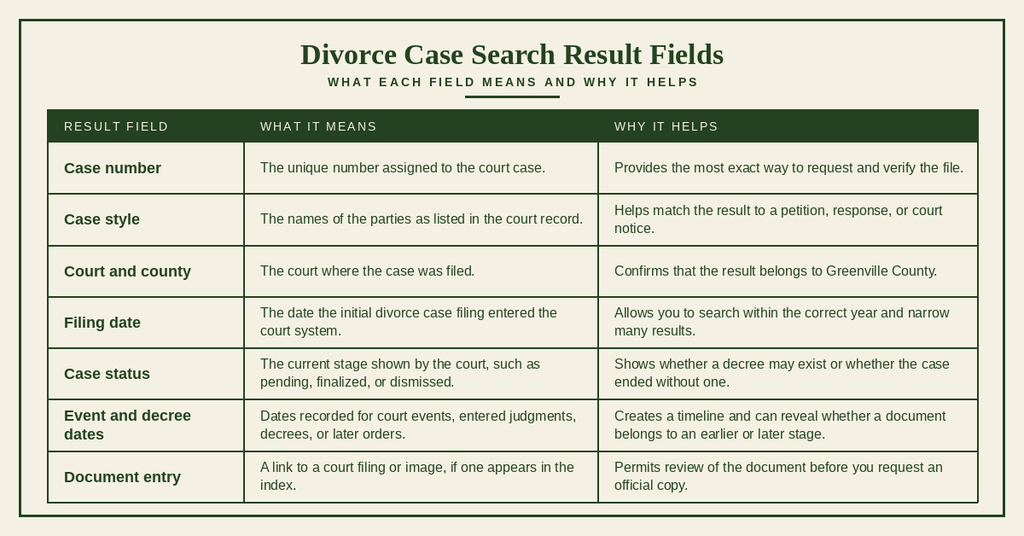
Treat the index as a case locator, not as proof of every fact shown in a document. The search screen can contain later postings or omit restricted pages. For a legal filing, estate decision, financial matter, or custody issue, ask the clerk for the certified record that matches the case number.
Filings, Decrees & Custody Terms
Title 15, Chapter 3 of the South Carolina Code of Laws provides the legal framework for dissolution of marriage. The Family Court handles these cases, and the Clerk of Court keeps the official case file. A case file may contain several different papers, so the case list and decree do not tell the entire story by themselves.
- The divorce petition or complaint opens the case and states the relief sought by the filing spouse.
- The answer or response gives the other spouse a chance to answer the allegations and raise disputed issues.
- Financial affidavits, property schedules, and settlement papers may support requests for property division or spousal support.
- Interim orders can address temporary support, custody, property, or other issues while the case remains pending.
- The final divorce decree states the court’s ruling after the case reaches its conclusion.
- Later motions and orders can change child support, custody, property terms, or another part of the decree after the case ends.
Certified Divorce Decrees & Judgment Dates
A final divorce decree is the court order that ends the marriage and states the terms of the ruling. The term divorce record can refer to the whole case file, including the petition, response, financial papers, hearing records, decree, and later orders. A certified copy is a clerk-issued duplicate of a selected document with the clerk’s certification.
The case filing date shows when the initial divorce petition or complaint was submitted to the court. A hearing date identifies a scheduled or completed hearing, if listed. The entered-judgment date indicates when the court formally recorded its judgment, while the decree date refers to the date shown on the final divorce decree or related court entry. An amended-decree date identifies a later court order that changed part of the original decree.
The filing, hearing, decree, and entered-judgment dates may fall on different days. A public index can also record an event date that differs from the date printed on a scanned paper. Check the decree itself and ask the clerk to confirm the operative dates if they conflict. If another agency requires an authenticated document, request a certified divorce decree rather than relying on an index entry or screen print.
Property Division & Spousal Support Logs
Property and support disputes often create several documents within one family court file. A search for Greenville County divorce records by name may locate the case, yet the public case entry may not show every financial term or settlement paper. The type of document determines where the term appears.
- Financial affidavits list income, expenses, assets, debts, and other financial facts used in the case.
- Marital property schedules identify assets and liabilities that the parties placed before the court.
- Property settlement agreements record the terms proposed by the spouses, often before the final hearing.
- Property division orders state the court’s ruling on real estate, vehicles, accounts, debts, retirement accounts, and other divided property.
- Spousal support orders set or change the amount, payment date, duration, or other terms of support, often called alimony in older records.
- Separation agreements may appear as private contracts or as papers filed with the court. A contract alone is not the same as a decree entered by the judge.
A settlement agreement can be private unless it was filed or incorporated into a court order. Once a judge enters an order, that order becomes part of the court record. Property deeds and tax records remain in separate county systems, so a family court file does not prove that a deed or tax account was changed.
Child Custody & Post-Divorce Modifications
Child-related terms can appear in the original decree or in later family court filings. South Carolina case files may use words such as custody, parenting plan, child support, and modification. You can also access bankruptcy records to review official records. Search the same spouse names and case style, then compare the dates because a later order may change the terms set years earlier.
- A parenting plan records arrangements for the care, decision-making, school time, holidays, and exchange of the children.
- A child custody order states the court ruling on legal custody, physical custody, or related parental responsibilities.
- A child support order sets the amount, payment method, and review terms for support.
- A modification petition asks the court to change a prior custody, support, or property term.
- A modification order states the court’s ruling after review of the requested change.
- Child support collection records may show payment activity handled outside the original decree.
How Post-Judgment Changes Appear
A post-judgment modification can remain under the original case number or receive a separate case number, depending on how the clerk files the matter. A related support or custody action may also use the same family case style with a different case number. If the original decree appears but a later support amount does not, ask the clerk to trace later filings under both spouses’ names. Do not assume the decree image reflects the current support, custody, or payment status.
Public Availability & Official Copies
The South Carolina Judicial Department public index supports public case searches. Its records are useful for finding a case, yet a search screen does not promise every document in the file. The Clerk of Court controls the official file and decides what may be copied under state rules, privacy rules, and court orders. The index can also omit sealed documents or filings outside its online scope.
Greenville County Clerk of Court Files and Search Logs
The Clerk of Court holds the official Greenville County family court records. Its files include pleadings, responses, exhibits, financial papers, hearing records, decrees, and post-judgment filings. The public index presents selected case data and may provide document images, but it does not replace the clerk’s file or a certified copy.
For an old Greenville County divorce case, ask whether the file is stored in the archive or another records system. A clerk search can use exact names, internal indexes, and case identifiers that a public name search may miss. If a recent filing is absent from the screen, ask the clerk for the date it entered the current index and whether the document image has been posted.
Confidential Child Data & Sealed Records
Not every paper in a family case can be viewed without limits. Privacy can arise from a court order, state law, the type of case, or protection of a child’s personal details. A visible case style does not prove that every document image is open for public viewing.
- A court may seal a case file or a document by entered order. The clerk can confirm the sealing status, yet a phone request does not lift the order.
- Records for juvenile matters, adoptions, and certain other sensitive family filings can be excluded from statewide public searches.
- Child-related documents may contain addresses, birth dates, Social Security numbers, medical details, or other identifiers that require protection.
- Financial papers can contain bank data, tax data, income, debts, and account numbers. Their online availability depends on the filing and any redaction or sealing order.
- Parties may place supporting material under seal when state rules and the court permit it, subject to review by a judge.
A case result can show the parties and docket events while withholding selected images. Ask the clerk whether a specific financial statement, custody order, or support paper is public, sealed, redacted, or stored only in the file. If you need a confidential section for a court matter, ask about the proper motion and hearing process. Also remove private identifiers from copies that you share outside the court or clerk’s office.
Certified Copies, ID Rules & Processing Fees
A certified divorce record is different from a printout made from a public search screen. The clerk’s certification confirms that the copy came from the official court record. For a certified divorce decree, give the clerk the case number and state exactly which document you need, such as the decree, a later support order, or both.
- Gather the case number, the legal names of both spouses, and the expected filing date. Correct details help the clerk find the correct Greenville County family court file.
- Identify the document and certification you need. Ask whether you want the final divorce decree, a separate certified supporting order, a complete file, or another clerk-issued copy.
- Ask about identification and request rules. The clerk can state whether photo identification, proof of party status, a signed application, or another form applies to your request.
- Confirm the fee before payment. Ask for the current amount, accepted payment method, and any separate charge for searching, certification, delivery, or archived records.
- Submit the request through the method approved by the clerk. Keep the receipt, request number, and a copy of every page sent with the request.
- Check the received copy before using it. Compare the case number, party names, decree date, signatures, and court seal with your request.
Before requesting a court document, confirm its exact title to avoid confusing a full case copy with a specific decree or order. Check identification requirements and the current fee, as charges may vary by request type. Verify accepted payment methods and whether payment must accompany the request. Also confirm the available delivery options, such as in-person collection or mail, and ask for an estimated processing time based on the clerk’s current workload.
No single fee or processing time fits every certified-copy request. The amount may depend on the record type, number of pages, certification, delivery, and archive work. The clerk can also explain when processing begins, which usually follows receipt of a complete request and accepted payment. Ask for a current estimate rather than relying on a date from an old search result or third-party page.
Record Accuracy & Resolution
Public indexes can contain spelling differences, late postings, and records outside online coverage. A missing result is a search problem rather than proof that a case does not exist. The safest path is to compare the search fields, check related filings, and ask the clerk to verify the court file by its exact number.
Matching Spouse Names & Case Numbers
Spouse names can be harder to match than most people expect. The court may preserve the legal name used at filing, list one party in a different order, or keep a former surname on the case style. Individuals can also check court docket to verify relevant details. A later name change does not always rewrite the historic caption.
- Enter the surname and given name used when the case was filed. Use the complete legal spelling shown on any petition or court notice.
- Try a former or alternate surname as a separate search when the form allows it. Do not combine two surnames unless the portal specifically provides that option.
- Remove extra punctuation and test the standard version of a hyphenated or compound surname. A search system may store names with different spacing.
- Compare both parties’ names and their order in the case style. A result showing only one spouse still may match the case you need.
- Use the full case number whenever it is known. Copy leading zeros and any suffix from the paper, since a shortened number can produce an incomplete match.
Name searches work best when the legal name has remained unchanged. A case number gives the clerk a firmer starting point because it points to one file and its related event history. If the number appears on an older document, verify the county and court before assuming it belongs to a current case with the same parties.
System Delays for Recent Filings
A newly filed case may not appear in the public index at once. The court may post a case after its own intake cycle, or a document image may enter the search system later. The index does not publish one fixed posting time for every filing type, so a short delay can occur without any problem with the case itself.
- A divorce petition may be accepted by the clerk before the case appears under a spouse’s name.
- A status or event entry may post before the related document image becomes available.
- A recently entered decree may lack an online image until the clerk finishes posting that document.
- A mistaken case type, county, or date range can remove a valid case from the visible results.
- An older case may sit in an archive rather than the current online set.
- A related post-judgment case may use another case number and remain outside the first search result.
For a filing deadline, hearing date, or legal submission, rely on the papers filed with the court and confirmation from the clerk. The public index can confirm that a record exists, yet it may not show the newest event. If an online entry conflicts with a paper you hold, give the clerk both the case number and the date printed on the paper so the clerk can compare the two records.
Unlisted Divorce Record Resolution
When a Greenville County divorce record is not found, work from the most exact identifier available. A case number outranks a name, and a signed filing outranks a date remembered years later. The clerk can also check cases filed under alternate name formats and related family court entries.
If a divorce case does not appear under a spouse’s name, try former surnames, alternate spellings, both parties’ names, and the expected filing year. If a known case number returns no result, verify every digit, suffix, county, and court with the clerk.
For pending cases or missing decree dates, ask the clerk to confirm the latest case status and check the docket for judgment and decree dates. Older cases may require an archived file search. If a later custody, support, or amended decree is missing, request a search for post-judgment filings linked to the original divorce case.
Keep a written note of each name, number, and date you tried. This record helps the clerk repeat or expand the search without repeating the same steps. Third-party record sites may copy index data and post it later, so use the official public index and the clerk’s office for the most current results. If a search result differs from the papers in your possession, request a certified copy for official use.
Contact Details
Ask the Greenville County Clerk of Court for divorce record verification when a result is missing, names do not match, or a certified copy is needed. Give the case number, both parties’ legal names, and the expected filing date before requesting a search. The office can confirm the current fee, identity rules, available copy methods, and processing estimate for your request.
Frequently Asked Questions
Below are common questions about finding and obtaining Greenville County dissolution of marriage records and related court documents.
How can I find a Greenville divorce case number?
Start with the Greenville County public index at the official website. Enter the parties’ names, filing year, or other known details. The search returns the case number, filing date, and status. This tool shows only summary data; it does not provide the full file. Once you have the case number, you can request the complete record from the Greenville County Clerk of Court.
Where to request a certified copy of a divorce decree?
Certified copies are issued by the Greenville County Clerk of Court located at 305 East North Street. Submit a written request that includes the case number, names of the spouses, and the filing date. Include a payment for the copy fee and a self‑addressed stamped envelope if you prefer mail delivery. The clerk will verify the request and mail the certified decree.
What info is shown in a Greenville dissolution search?
The public index displays the case number, date the petition was filed, current case status, and the type of judgment issued. It may also list the judge’s name and a brief docket summary. The index does not contain the full petition, financial details, or child‑related orders. For those documents, you must request the full file from the clerk.
How long does a divorce record request take?
Processing time varies, but most requests are completed within two to three weeks after the clerk receives a complete application and payment. Requests for older or archived files may require additional handling, extending the timeline. If you need the record urgently, ask the clerk about any expedited service options and associated fees.
Can I view Greenville divorce records online for free?
The public index on the Greenville County website lets anyone search case summaries at no cost. However, full documents, such as the divorce decree or judgment, are not available online for free. To obtain those, you must submit a request to the clerk and pay the required copy fees.